Sun Spots and Pigmentation: Causes and Professional Treatment Options
You’ve probably noticed them creeping in — flat brown or greyish patches on your cheeks, forehead, or the backs of your hands. Sun spots and pigmentation are among the most common skin concerns we see at Beauty & Laser Windsor, and also among the most misunderstood when it comes to what actually helps.
Here’s a straightforward look at why they form, what the different types mean, and which professional options are available to help fade them.
What Causes Sun Spots and Pigmentation?
Pigmentation is driven by melanin — the same pigment responsible for your skin and hair colour. When the skin is exposed to UV radiation, physical damage, inflammation, or hormonal changes, it can produce excess melanin in localized areas, resulting in darker patches or spots.
The specific trigger determines the type of pigmentation — and the type determines the most effective approach to improving its appearance.
UV exposure is the most common cause of sun spots (also called solar lentigines). Years of sun exposure cause melanocytes in the skin to become overactive in certain areas, producing concentrated melanin deposits that appear as flat, well-defined brown spots.
Hormonal changes — particularly during pregnancy, while using hormonal contraceptives, or during perimenopause — can trigger melasma, a more diffuse and often symmetrical form of pigmentation, typically appearing on the cheeks, upper lip, and forehead.
Post-inflammatory hyperpigmentation (PIH) develops after skin injury or inflammation — most commonly after acne breakouts, but also after cuts, rashes, or any procedure that disrupts the skin. It appears as flat dark or reddish marks where the inflammation occurred.
Freckles are genetically determined and increase in visibility with sun exposure. Unlike sun spots, they often fade somewhat in winter.
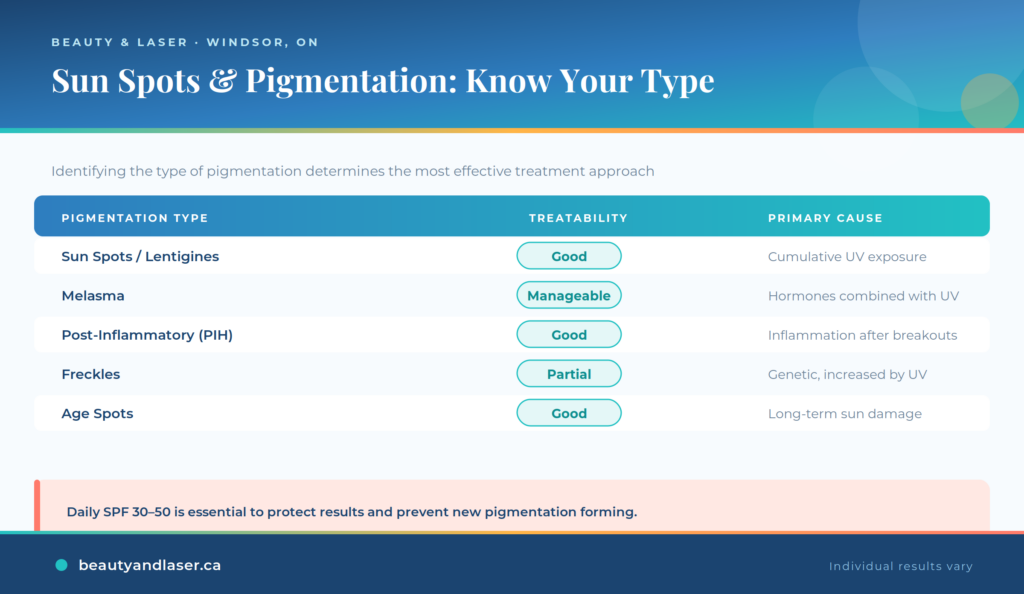
Types of Pigmentation
Understanding which type you’re dealing with helps clarify what to expect from treatment.
| Type | Appearance | Common Cause | Treatability |
|---|---|---|---|
| Sun spots / solar lentigines | Flat, well-defined brown spots | Cumulative UV exposure | Responds well to professional treatment |
| Melasma | Diffuse, symmetrical patches | Hormones + UV | Can be managed; prone to recurrence |
| PIH | Flat dark/red marks post-breakout | Inflammation | Often fades with treatment |
| Freckles | Small, scattered | Genetic + UV | Can be lightened; not fully eliminated |
Why Sunscreen Isn’t Enough
SPF is essential for preventing new pigmentation and protecting skin during and after treatment — but it doesn’t address melanin that has already accumulated in the skin. Sunscreen blocks UV before it reaches the skin; it has no mechanism for reducing existing pigment deposits.
Similarly, over-the-counter brightening products (vitamin C, niacinamide, kojic acid) can modestly slow new pigment production and improve overall luminosity, but they can’t meaningfully reach the depth at which established sun spots and melasma are anchored. For visible, lasting improvement of existing pigmentation, professional treatments that target melanin directly or accelerate skin renewal at a deeper level are required.
IPL vs Laser vs Chemical Peel for Pigmentation
These three approaches work through different mechanisms, and the right choice depends on the type of pigmentation, your skin tone, and how significant the concern is.
IPL (Intense Pulsed Light)
IPL emits broad-spectrum light across multiple wavelengths, which is absorbed by the melanin in pigmented spots. The absorbed energy generates heat that breaks down the concentrated melanin, allowing the body to gradually clear it. IPL is most effective for sun spots and freckles on lighter skin tones where the contrast between the spot and the surrounding skin is high.
IPL is less suitable for melasma (it can sometimes worsen it by stimulating melanocytes) and carries higher risk on darker skin tones due to the risk of pigmentation changes from the non-specific heat. A proper skin assessment is essential before booking IPL for pigmentation.
Laser Treatment
Lasers use a single, precise wavelength of light rather than the broad spectrum of IPL, allowing more targeted energy delivery to the pigmented area. This precision makes laser a stronger option for more stubborn or deeper pigmentation, and certain laser wavelengths are better suited to specific types of spots.
At Beauty & Laser Windsor, our Asclepion MeDioStar Monolith laser can be calibrated to address pigmentation concerns alongside other skin goals, with settings adjusted for your specific skin tone and pigment type.
Chemical Peels
Chemical peels accelerate the shedding of the skin’s outermost layers, carrying pigmented cells away with them and stimulating fresh, more evenly-toned skin renewal from beneath. They’re particularly effective for PIH and surface-level sun spots, and they work well as a complementary treatment alongside laser or IPL rather than as a standalone solution for significant pigmentation.
Salicylic and glycolic acid peels are commonly used for PIH and mild sun damage. For melasma, peels can help but must be used carefully — the wrong type or depth can trigger a rebound flare.
Learn more about which peel types suit different concerns in our chemical peels guide.
What to Expect from Treatment
Results from pigmentation treatments are gradual and cumulative — and ongoing sun protection is essential to maintain them.
For sun spots with IPL or laser, most clients notice the spots initially appearing darker and more defined in the days after treatment (a normal response as the pigment rises to the surface before shedding) followed by visible fading over 2–4 weeks. Multiple sessions are typically needed for full results.
For melasma, results are more variable. Melasma is among the most challenging pigmentation types because hormonal and UV triggers can cause recurrence even after successful treatment. A maintenance plan and strict, consistent sun protection are essential components of managing it long-term.
For PIH, a series of peels combined with appropriate skincare often produces visible improvement within 6–8 weeks, with continued fading over the following months.
Prevention
Regardless of which treatment you pursue, the following habits are non-negotiable for both preventing new pigmentation and protecting your results:
Apply SPF 30–50 daily, even on cloudy days and during winter in Windsor. UV reaches the skin year-round, and without daily protection, new spots form and treated areas can repigment.
Reapply sunscreen if you’re outdoors for extended periods — a single morning application isn’t sufficient for all-day protection.
Wear protective clothing and seek shade during peak sun hours, particularly in summer.
Address hormonal triggers if possible — for clients whose pigmentation is primarily driven by hormonal contraceptives, discussing alternatives with a healthcare provider may be worth considering alongside any cosmetic treatment.
Frequently Asked Questions
Can pigmentation be fully eliminated?
Sun spots and PIH can often be significantly reduced in appearance with appropriate treatment. Melasma is more complex — it can be meaningfully improved but is prone to recurrence with sun exposure or hormonal changes, and ongoing management is typically needed.
How many sessions will I need?
This depends on pigmentation type and depth. Sun spots may improve significantly after 1–2 laser or IPL sessions. PIH typically benefits from a series of 4–6 peels. Melasma often requires ongoing maintenance rather than a fixed number of sessions.
Is pigmentation treatment safe for darker skin tones?
Some methods — particularly IPL — carry higher risk for darker skin tones (Fitzpatrick IV–VI) and are not always appropriate. Gentler chemical peels and certain laser protocols can be safer options when properly calibrated. A thorough consultation and skin assessment is essential. Our guide on laser treatment for dark skin covers the principles we apply to all treatments involving melanin-rich skin.
Can I get pigmentation treatment in summer?
Professional pigmentation treatments should ideally be performed when sun exposure can be minimized, as UV exposure before or after treatment increases the risk of rebound pigmentation. See our guide on the best time to start laser treatment for more on why timing matters.
Book a Pigmentation Consultation
The right approach depends on your pigmentation type, skin tone, and history. A consultation lets us assess your skin and recommend the most appropriate, safest treatment path.
👉 Book your consultation or explore our range of facial treatments.