Botox vs Fillers: A Complete Guide for First-Timers
If you’re new to injectables, the terminology alone can be confusing. “Should I get Botox or filler?” is one of the most common questions we hear at consultations — and the answer depends entirely on what you’re looking to address, because the two work in completely different ways.
This guide explains everything a first-timer needs to know, without the jargon.
What Is Botox?
Botox is the brand name for botulinum toxin type A — a purified protein that, when injected into a specific muscle in a carefully controlled dose, temporarily reduces that muscle’s ability to contract. In cosmetic use, this relaxation of targeted muscles softens the lines and creases caused by repeated facial movement.
It’s important to understand that Botox works on dynamic wrinkles — those caused by muscle movement. When you squint, frown, raise your eyebrows, or smile, the same muscles repeatedly fold the skin in the same places over years, eventually creating visible lines even when your face is at rest.
By reducing muscle contraction in these areas, Botox softens existing dynamic lines and — with consistent use over time — may help reduce the deepening of new ones.
In Canada, botulinum toxin is a prescription drug regulated by Health Canada and must be administered by or under the supervision of a qualified regulated health professional. At Beauty & Laser Windsor, all injections are performed by our qualified team in accordance with these requirements.
Common areas addressed with Botox:
- Forehead horizontal lines
- Frown lines between the brows (glabella)
- Crow’s feet around the eyes
- Brow shaping and subtle lift
- Bunny lines on the nose
- Lip lines and lip flip
- Neck bands (platysma)
- Jaw area (masseter) for facial contouring
What Are Fillers?
Dermal fillers are injectable substances that add volume, structure, or hydration to specific areas of the face. Unlike Botox, which works by relaxing muscles, fillers work by physically filling a space — replacing lost volume, defining contours, or smoothing areas that have become hollow or deflated with age.
The most commonly used fillers are based on hyaluronic acid (HA) — a substance naturally found in the skin that holds moisture and gives tissue its plumpness. HA fillers are reversible, meaning they can be dissolved with an enzyme called hyaluronidase if a client is unhappy with the result — a significant safety advantage.
Other filler types include Radiesse, a calcium-based biostimulator that provides structure and stimulates the body’s own collagen production, available at Beauty & Laser as part of our face lifting treatments.
Fillers address volume loss and structural concerns — things that Botox cannot help with, since they’re not caused by muscle movement.
Common areas addressed with fillers:
- Lips (volume, definition, symmetry) — see our lip filler page
- Cheeks (volume restoration, lift)
- Nasolabial folds (lines from nose to mouth)
- Marionette lines (lines from mouth to chin)
- Under-eye hollows (tear troughs)
- Jawline definition
- Chin projection
How Each Works Differently
This is the key distinction that determines which treatment — or combination — is right for your concern:
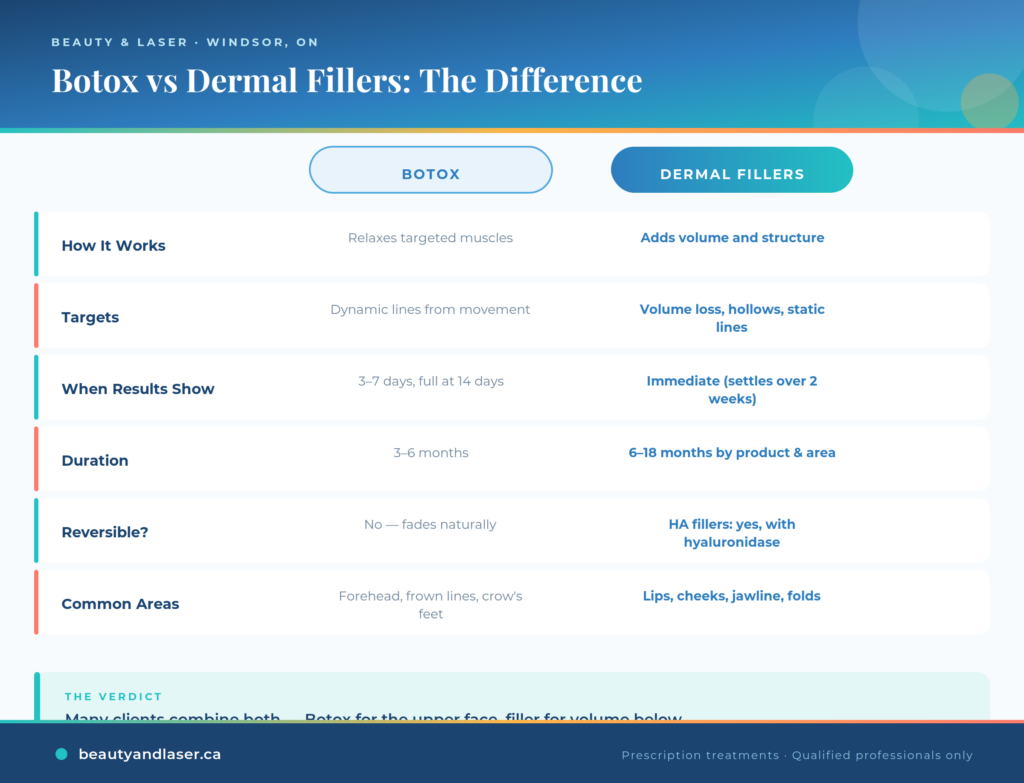
| Botox | Dermal Fillers | |
|---|---|---|
| Mechanism | Relaxes muscles | Adds volume and structure |
| Target | Dynamic wrinkles (caused by movement) | Volume loss, hollows, static lines |
| Onset | 3–7 days | Immediate (with some swelling initially) |
| Duration | 3–6 months | 6–18 months depending on product and area |
| Reversible? | No — fades naturally | HA fillers: yes, with hyaluronidase |
| Pain | Minimal | Mild, managed with numbing cream |
Areas Best Treated by Each
A common misconception is that either treatment can address any concern. In reality, using the wrong approach for a specific concern produces disappointing results.
Use Botox for: Lines caused by muscle movement — forehead lines when you raise your brows, the vertical crease between your brows when you frown, crow’s feet when you squint. If the line disappears when your face is completely relaxed, it’s primarily a dynamic line — well-suited to Botox.
Use fillers for: Volume loss that’s visible regardless of expression — sunken cheeks, hollow under-eyes, flat lips, nasolabial folds that are deep at rest. If the concern is present even when your face is still, filler is likely the more appropriate approach.
Use both for: Many clients benefit from combining both in a complementary plan. A common approach is Botox to soften dynamic lines in the upper face, combined with fillers to restore volume in the mid or lower face. The two products don’t interfere with each other and can often be done in the same appointment when planned appropriately.
Can You Combine Them?
Yes — and this is often where the best overall results come from. A treatment plan using both Botox and fillers, placed in different areas or targeting different concerns, is sometimes called a “liquid lift” and is one of the most requested approaches for clients in their 30s and 40s looking for comprehensive rejuvenation without surgery.
For example: Botox to soften forehead lines and crow’s feet + filler to restore cheek volume and define the jawline = a more balanced, natural-looking improvement than either treatment could achieve on its own.
If you’re interested in a non-surgical lifting approach, explore our face lifting with hyaluronic fillers and Radiesse service, and our Morpheus8 RF skin tightening option, which can further complement injectable results.
First Appointment: What to Expect
Consultation: Your provider reviews your concerns, assesses your facial anatomy, and recommends which treatment (or combination) is most appropriate. This is also the time to ask every question you have — there are no silly ones.
Preparation: Before Botox, avoid blood-thinning medications and alcohol for 24 hours. Before fillers, the same applies to minimize bruising. Arrive with clean skin and no makeup on the treatment area.
The treatment itself: Both procedures are performed using fine needles. Botox injections are brief and involve minimal discomfort. Filler appointments are slightly longer depending on the areas treated, and numbing cream is applied beforehand for comfort. Most clients are surprised by how quick and straightforward both are.
Immediately after: Botox requires minimal downtime — a few precautions for the first 4 hours, then normal life resumes. Fillers may cause some swelling and mild bruising, particularly for lip filler, which typically resolves within a few days. See our full Botox aftercare guide for post-treatment instructions.
Seeing results: Botox takes 3–14 days to fully take effect. Filler results are visible immediately, though the final result is best assessed at 2 weeks once swelling has resolved.
Cost Comparison
In Canada, injectable pricing is typically charged per unit (Botox) or per syringe (fillers) rather than by area treated.
Botox: Charged per unit. The number of units varies by area and individual muscle strength — most standard areas (forehead + glabella + crow’s feet) require 30–60 units total for a full upper-face treatment. Our current promotional pricing starts at $140 CAD / $100 USD for 20 units. See our pricing page for current offers.
Fillers: Priced per syringe (1ml). Lip augmentation typically uses 0.5–1ml; cheek or jawline work may use 1–2ml per side. Pricing varies by product — see our pricing page or book a consultation for a personalized quote.
Frequently Asked Questions
I’m in my late 20s — is it too early?
No. Many clients in their mid-to-late 20s start with small amounts of Botox as a preventive measure, targeting the areas where their most pronounced dynamic lines are forming. Starting early with conservative doses is generally more effective than waiting until lines are deeply set. For fillers, most people in their 20s don’t yet need significant volume restoration, though lip filler for enhancement (rather than correction) is popular at any adult age.
Will I look frozen or unnatural?
Not with appropriate dosing and placement. Botox that produces a frozen, expressionless look is almost always the result of too many units or incorrect placement. A skilled, conservative approach preserves natural expression while softening lines.
Does it hurt?
Both treatments are well-tolerated by most clients. Botox injections are very brief and involve minimal discomfort. Filler appointments are slightly longer, and numbing cream is used to keep the experience comfortable.
How do I know which I need?
Book a consultation — this is genuinely the most reliable answer. An experienced provider can assess your specific concerns, your anatomy, and your goals and make a clear, honest recommendation. You’re never obligated to proceed on the same day.
What’s the difference between fillers and Radiesse?
Hyaluronic acid fillers add volume and can be dissolved. Radiesse is a calcium-based biostimulator that provides more structural support and stimulates the body’s own collagen — it’s less reversible but often longer-lasting and better suited to areas needing more lift than hydration. Learn more on our face lifting page.
Book a Free Injectable Consultation
New to injectables and not sure where to start? A consultation is the best first step — we’ll walk you through exactly which treatment addresses your specific concerns and what a realistic plan looks like.
👉 Book your free injectable consultation or explore individual treatment pages: Botox | Lip Filler | Face Lifting.