How Long Does Botox Last? Everything You Need to Know
“How long will it last?” is consistently one of the first questions people ask before their first Botox appointment — and the honest answer is more nuanced than the standard “3–4 months” you’ll find on most clinic websites. Duration varies meaningfully from person to person, treatment area to treatment area, and even session to session for the same client.
Here’s a thorough breakdown of what actually determines how long your results last, and what you can do to support longevity.
Average Botox Duration by Treatment Area
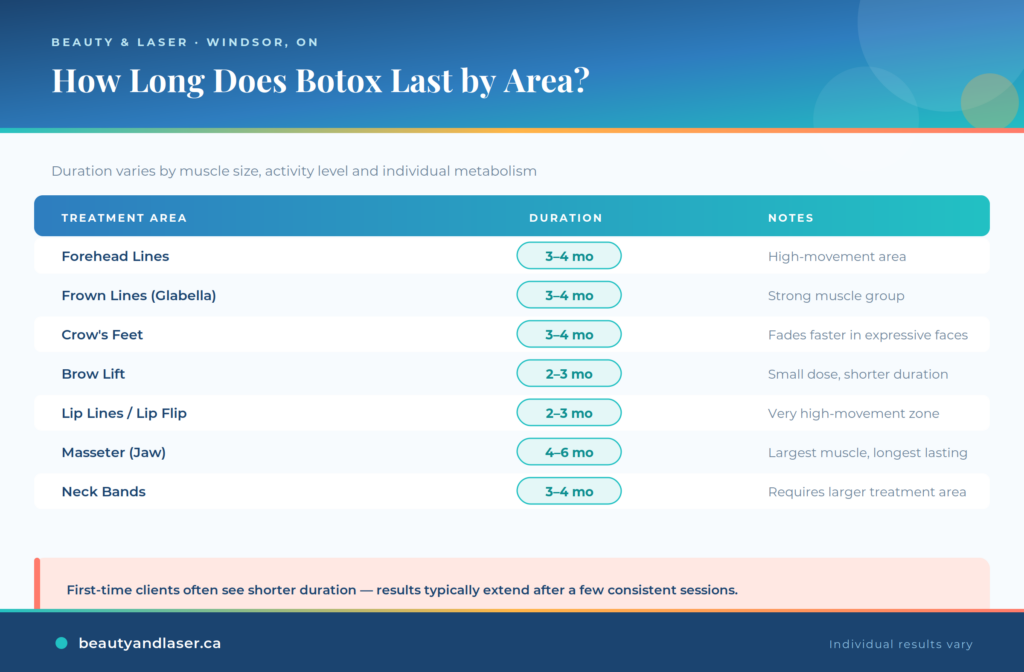
The duration of Botox results isn’t uniform across the face. Different muscles have different activity levels, sizes, and metabolic rates — all of which affect how quickly the product is processed.
| Treatment Area | Typical Duration |
|---|---|
| Forehead lines | 3–4 months |
| Frown lines (glabella / between brows) | 3–4 months |
| Crow’s feet | 3–4 months |
| Brow lift | 2–3 months |
| Bunny lines (nose) | 3–4 months |
| Lip lines / lip flip | 2–3 months |
| Masseter (jaw slimming) | 4–6 months |
| Neck bands (platysma) | 3–4 months |
Areas with more frequent or intense muscle movement (like the forehead and crow’s feet in very expressive faces) tend to metabolize the product faster. The masseter muscle, treated for jaw slimming or bruxism-related concerns, is one of the longest-lasting areas because the muscle is large and requires higher doses, and when well-relaxed, it’s a less dynamically active area overall.
What Affects How Long It Lasts
Metabolism Rate
Your body’s metabolic rate is one of the biggest individual variables. People with faster metabolisms — whether from genetics, high activity levels, or other factors — tend to process the product more quickly.
Exercise Intensity
High-intensity exercise consistently correlates with faster Botox breakdown in many clients. The increased circulation and muscle activity associated with frequent intense training accelerates how quickly the product is metabolized. Clients who train at high intensity several times per week may find their results last on the shorter end of the range.
Dose and Injection Technique
The units of product used and the precision of placement significantly affect longevity. Undertreating an area (too few units) may produce results that fade faster and less gracefully. Accurate, appropriately dosed injections placed at the correct anatomical sites produce the most natural results with the best longevity.
This is one of the most important reasons to choose an experienced, qualified injector rather than simply seeking the lowest-priced option.
Stress and Cortisol Levels
Chronic high stress and elevated cortisol levels are associated with faster breakdown of Botox in some clients. Cortisol influences many metabolic processes in the body, and its effects on injectable longevity, while not fully studied, are commonly observed clinically.
Sun Exposure and Skin Health
Consistent UV exposure and skin inflammation accelerate skin aging processes generally — and are associated with faster breakdown of both Botox and dermal fillers. Clients who maintain consistent SPF use and good skin health practices tend to report longer-lasting results over time.
First-Time vs Repeat Clients
First-time Botox clients often find their results don’t last quite as long as subsequent treatments. This is a well-observed clinical pattern — the muscles haven’t yet been trained into a pattern of reduced contraction, and the full muscle-relaxing effect may take a couple of sessions to fully establish. Many clients find their duration extends to 4–6 months after the first few consistent treatments.
How to Make Results Last Longer
While you can’t dramatically change how your body processes the product, several consistent habits are associated with longer-lasting results.
Daily SPF. UV exposure is associated with faster skin aging and accelerated product breakdown. A consistent broad-spectrum SPF 30–50 habit is one of the most impactful things you can do for both your skin and the longevity of your results.
Avoid prolonged extreme heat. Saunas, steam rooms, and very hot environments increase circulation and can mildly accelerate product breakdown, particularly in the period immediately after treatment. Moderation is key.
Follow aftercare diligently. The first 24 hours after your injection are the most critical for allowing the product to settle correctly. See our complete Botox aftercare guide for the full checklist.
Book your next appointment before results fully wear off. Consistent maintenance — booking your follow-up before the product has fully metabolized — tends to produce more stable, natural-looking results over time than allowing muscles to fully return to baseline movement between sessions. Many clients find a 3–4 month schedule works well for most areas.
Consider complementary skin treatments. Clients who combine Botox with skin-quality treatments like Morpheus8, mesotherapy, or facials often find that the overall improvement in skin health and texture makes results look better and feel more satisfying over a longer period — even if the product duration itself isn’t extended.
When to Book a Touch-Up
Most clients settle into a maintenance schedule of every 3–4 months for facial areas and every 4–6 months for masseter treatment. The best time to rebook is when you notice the first signs of muscle movement returning — not after results have fully worn off.
Booking a touch-up while some effect is still present often means slightly fewer units are needed to restore the result, as you’re maintaining a partially relaxed muscle rather than starting from scratch.
For a full picture of what injectable options complement Botox, see our guide on Botox vs fillers for first-timers.
Frequently Asked Questions
Why did my Botox only last 6 weeks?
Very short duration — less than 8 weeks — can sometimes indicate the product didn’t fully take effect, or that dosing was insufficient for the area. It can also reflect individual metabolic factors. If this happens consistently, discuss it with your provider — dosing adjustments or a different injection strategy may help.
Does Botox last longer the more you get it?
Many clients do report progressively longer-lasting results after consistent treatments over 1–2 years. This is thought to be related to gradual muscle atrophy from sustained reduction in contraction — over time, the muscle itself may become slightly less active even between treatments.
Can I make Botox last longer with supplements?
Some practitioners mention zinc supplementation as a potential factor in Botox longevity — the theory being that zinc plays a role in how botulinum toxin binds to muscle receptors. The evidence is limited and not definitive, but it’s generally harmless. Discuss any supplement use with your provider if you’re interested.
Is it safe to get Botox every 3 months?
Yes — for most clients, a consistent 3–4 month maintenance schedule is standard, safe, and clinically well-established. There’s no evidence of harm from consistent, appropriately dosed treatments on this schedule.
Does Botox wear off all at once?
No — it fades gradually as the muscle slowly regains its function. Most clients notice it starting to wear off over 2–4 weeks rather than experiencing a sudden return of movement.
Book Your Botox Appointment
Our qualified team will assess your goals, recommend appropriate dosing for your specific anatomy, and discuss a maintenance schedule that works for your lifestyle.
👉 Book your Botox appointment or view our current pricing.