How to Get Rid of Acne Scars: Best Treatments in 2026
Breakouts are frustrating enough on their own. The marks they leave behind can feel even more discouraging — especially when you’ve tried product after product with little to show for it. If you’re looking into professional acne scar treatment in Windsor, Ontario, here’s what actually works and why.
Types of Acne Scars
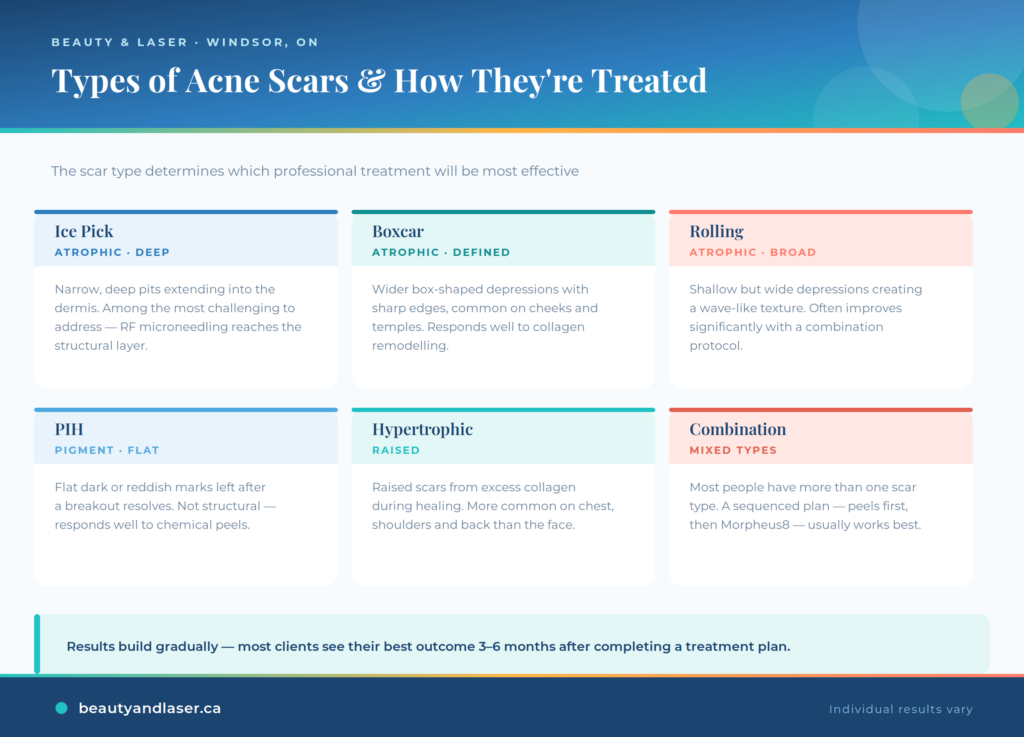
Not all acne scars are the same, and the type you have influences which treatment will be most effective. Understanding the difference helps set realistic expectations before committing to a treatment plan.
Atrophic Scars (Depressed)
These are the most common type and appear as indentations or depressions in the skin. They form when a blemish damages the collagen and underlying tissue during healing, leaving a pitted or sunken appearance. Atrophic scars are further divided into:
Ice pick scars — narrow, deep pits that extend into the dermis, often the most difficult to address.
Boxcar scars — wider, box-shaped depressions with defined edges, most commonly found on the cheeks and temples.
Rolling scars — shallow but broad depressions that give the skin an uneven, wave-like texture.
Post-Inflammatory Hyperpigmentation (PIH)
Technically not a scar in the structural sense, PIH refers to the flat dark or reddish marks left after a blemish resolves. These are caused by excess melanin production during healing and tend to fade on their own over time — but professional treatments can significantly speed up that process.
Hypertrophic and Keloid Scars
Less common in acne, these raised scars form when the body produces too much collagen during healing. They’re more frequently seen on the chest, shoulders, and back than on the face.
Why Home Remedies Don’t Work
The honest reason home remedies fall short for true acne scarring is depth. Products applied to the skin’s surface — no matter how well-formulated — can only reach the outermost layers of the skin. Atrophic scars and PIH both involve changes at a deeper structural level, where topical products simply can’t reach with meaningful effect.
Vitamin C serums, niacinamide, and retinoids can support skin health and modestly improve the appearance of PIH over a long period, but they won’t meaningfully change the texture of pitted scarring. For visible, lasting improvement, the skin needs to be stimulated from within — which is exactly what professional treatments are designed to do.
Morpheus8 RF Microneedling for Acne Scars
Morpheus8 is one of the most effective options currently available for atrophic acne scarring, and it’s available at Beauty & Laser Windsor.
It combines two established mechanisms — microneedling and radiofrequency (RF) energy — delivering both in a single treatment. The microneedles create controlled micro-channels in the skin, while the RF energy penetrates into the deeper dermal layers, generating heat that stimulates collagen and elastin production from within.
For acne scars specifically, this dual mechanism addresses both the surface texture and the underlying structural deficiency — filling in the depressed areas gradually as new collagen remodels the scar tissue over the weeks following treatment.
Most clients see meaningful improvement after 2–3 sessions, spaced 4–6 weeks apart, with continued collagen remodeling visible for several months after completing a course. It’s also safe across a wide range of skin tones, including darker complexions where some other resurfacing methods carry higher risk — a detail worth noting for many Windsor clients. For more on skin tone considerations, see our guide on laser hair removal for dark skin, which covers the Fitzpatrick scale and melanin-related treatment adjustments we apply across all our services.
Chemical Peels for Acne Scars
Chemical peels work by applying a carefully formulated acidic solution to the skin, accelerating the shedding of the outermost skin layers and stimulating renewal from beneath. For acne scarring, they’re most effective for:
Post-inflammatory hyperpigmentation (PIH) — peels can visibly accelerate the fading of dark marks left behind after breakouts, particularly glycolic and salicylic acid peels.
Mild surface texture irregularities — superficial to medium-depth peels can improve the overall smoothness of skin affected by rolling or very shallow boxcar scars.
Peels are a gentler and often more affordable starting point than RF microneedling, and they’re frequently used as part of a multi-step protocol — beginning with a series of peels to improve surface clarity, then progressing to Morpheus8 for deeper structural improvement.
The number of sessions needed depends on scar depth and skin type. For PIH, a series of 4–6 peels spaced 2–4 weeks apart is a typical starting plan. For more textural concerns, medium-depth peels may be appropriate, assessed during your consultation.
Combining Treatments for Better Results
For moderate to significant acne scarring, a combination approach tends to produce noticeably better outcomes than any single treatment alone.
A common protocol at Beauty & Laser Windsor involves starting with a series of chemical peels to improve surface clarity and reduce PIH, followed by a course of Morpheus8 RF microneedling to address deeper textural improvement and scar remodeling. This sequence allows the skin to be in its best condition before the more intensive treatment, and the results of each build on the other.
Combining treatments also allows your provider to calibrate intensity appropriately at each stage — rather than attempting to address everything with a single aggressive session that increases recovery time and risk.
You can read more about how Morpheus8 compares to other skin improvement methods in our guide on Morpheus8 vs traditional facelift.
Results Timeline
Managing expectations is as important as choosing the right treatment. Acne scar improvement is a gradual process — the skin’s collagen remodeling cycle takes time, and the most significant changes often appear weeks to months after completing a course of treatment rather than immediately after.
A general guide:
After chemical peels: Improved brightness and PIH reduction are typically visible within 2–3 weeks of the peeling phase resolving. Texture improvement from a series of peels develops over 2–3 months.
After Morpheus8: Initial skin tightening and surface improvement are often noticeable within 2–4 weeks. Deeper collagen remodeling — including the most meaningful scar improvement — continues for up to 3–6 months after completing the recommended number of sessions.
Combination protocol: Most clients who complete a full combination plan see their best results at the 3–6 month mark after finishing treatment, with continued improvement in the months that follow.
Frequently Asked Questions
Which treatment is best for deep pitted acne scars?
Morpheus8 RF microneedling is generally the most effective option for deeper atrophic scarring (ice pick, boxcar, rolling), as it targets the structural tissue beneath the skin’s surface rather than just the outer layers. For very deep or complex scarring, a consultation is the best way to assess which combination of treatments is most appropriate.
How many sessions will I need?
This varies significantly by scar type and depth. For PIH alone, 4–6 chemical peel sessions may produce visible results. For moderate atrophic scarring, a typical plan might include 2–3 Morpheus8 sessions, potentially combined with preparatory peels. Your provider will outline a realistic plan at your consultation.
Will my acne scars go away completely?
Professional treatments can produce significant, visible improvement — often dramatically so — but complete elimination of deep structural scarring is not always achievable. The goal is meaningful, lasting improvement that makes scarring far less visible in normal lighting and skin conditions.
Are treatments safe for sensitive or darker skin?
Morpheus8 is considered safe across all Fitzpatrick skin types, including darker complexions. Chemical peels require more care for darker skin tones — specifically, lighter superficial peels are generally preferred to reduce the risk of post-inflammatory hyperpigmentation from the peel itself. A proper skin assessment at consultation determines the safest approach for your specific skin tone.
How soon can I start treatment after my acne has cleared?
Generally, it’s recommended to wait until active breakouts in the treatment area have fully resolved before beginning resurfacing treatments like peels or Morpheus8. If you’re still experiencing active acne, your provider can guide you on the right timing and sequence.
Book an Acne Scar Consultation
The right treatment plan depends on your specific scar type, skin tone, and goals. A consultation lets us assess your skin in person and recommend the most appropriate sequence and combination of treatments for your situation.
👉 Book your acne scar consultation or learn more about Morpheus8 and our facial treatments.