
Natural-Looking Lip Fillers: How to Avoid the ‘Overdone’ Look
The fear of ending up with obviously overfilled lips is the number one reason people hesitate before booking a lip filler consultation — and it’s completely understandable. We all know what “overdone” looks like. But the truth is that unnatural-looking results are almost never about lip filler itself — they’re the result of too much product, the wrong placement, or misaligned expectations between client and injector.
Natural-looking lip filler in Windsor is entirely achievable. Here’s how.
Why Some Lip Fillers Look Unnatural
Before getting into technique, it helps to understand what actually creates an overdone look — because knowing this makes it much easier to avoid.
Too much volume. The most common cause. Lips have a natural proportion relative to the rest of the face, and exceeding that proportion — regardless of how well the filler is placed — will look unnatural. The goal of a natural result is enhancement within the range of what your face can accommodate, not maximum volume.
Incorrect placement. Filler placed too far outside the vermillion border (the lip’s natural edge), or in the wrong plane of tissue, can create the “duck lip” or “shelf” effect where the lips look flat, projected forward rather than upward, or misshapen.
Ignoring the lip’s natural anatomy. Every person’s lips have an individual shape — the cupid’s bow, the philtrum columns, the natural ratio between upper and lower lip. Treating all lips the same way ignores this and produces results that look foreign on the face.
Wrong product choice. Different hyaluronic acid fillers have different viscosities, cohesiveness, and lift characteristics. Using a product designed for deeper structural support in the delicate lip tissue, or using a very fluid product where more definition is needed, contributes to unpredictable or unnatural results.
Gradual accumulation without dissolving. Hyaluronic acid filler is gradually absorbed by the body over time, but repeated top-ups without dissolving previous product can lead to gradual overfilling that’s hard to notice in the mirror session-by-session but striking in photos over time.
The Anatomy of the Lip
Understanding your own lip anatomy helps you have a more informed conversation with your injector — and helps you communicate what you actually want.
Vermillion border: The defined edge that separates lip tissue from skin. Sharp, defined borders contribute to a youthful, articulated appearance. Filler can be used to subtly restore or define this edge without visibly enlarging the lip.
Cupid’s bow: The double curve at the centre of the upper lip. Its definition is a key component of natural-looking lip filler — well-placed filler should enhance the cupid’s bow rather than flatten it.
Philtrum columns: The two ridges running from the upper lip to the base of the nose. Their depth and definition contributes to lip projection and youthful appearance.
Lip body: The main volume of the lip. Volume here needs to be added in proportion to the overall lip size and face — this is where most clients want the fullness, and where over-injection most commonly occurs.
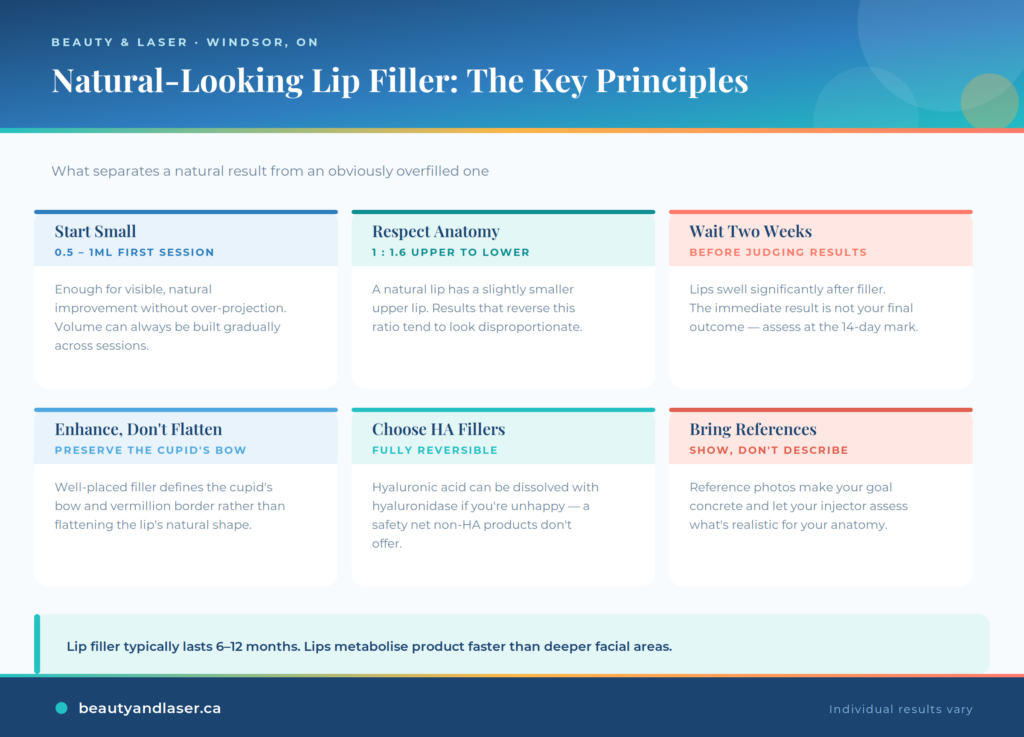
Upper-to-lower ratio: A natural lip typically has a slightly smaller upper lip than lower lip. The classic natural ratio is approximately 1:1.6 (upper to lower). Results that push the upper lip significantly beyond the lower lip tend to look disproportionate.
How We Approach Lip Augmentation at Beauty & Laser
At Beauty & Laser Windsor, lip filler is approached from the perspective of your individual lip anatomy and facial proportions — not a template.
The consultation phase is where this starts. Before any product is placed, we assess your natural lip shape, the current upper-to-lower ratio, the condition of your vermillion border, and what your specific goals are. Clients who say “I want natural fullness” often mean something different than clients who say “I want a defined cupid’s bow with more volume” — and the injection approach differs accordingly.
We use premium hyaluronic acid fillers selected for their specific suitability for lip tissue — products with appropriate softness and cohesiveness that move naturally with the lips and integrate well with the surrounding tissue.
Hyaluronic acid has a significant practical advantage beyond its biocompatibility: it’s reversible. If a client is unhappy with the result, hyaluronidase enzyme can be used to dissolve the filler — a safety net that non-HA products don’t offer.
How Much Filler Is Enough?
This is where many clinics go wrong — not from incompetence but from responding to client pressure for more volume in a single session.
For most first-time lip filler clients, 0.5–1ml is an appropriate starting point — enough to produce a visible, natural improvement without risking over-projection. The result can always be built upon gradually. Once product is in place, it takes 2 weeks to fully settle — and what looks like “not enough” immediately after injection often looks natural and proportionate at the 2-week mark.
Starting conservatively and building gradually over multiple sessions is the approach that consistently produces the most natural, long-lasting satisfaction.
Communicating Your Goals
The clearest way to communicate what you want is through reference photos — bring images of lips you consider attractive and natural, rather than just describing in words. Visual references make the goal concrete and allow your injector to assess whether the reference is achievable for your specific anatomy.
Be specific about what you want to improve. “Fuller” is vague. “I want more volume in the body of the lip with a clearer definition of the cupid’s bow, without making the upper lip bigger than the lower” is precise and actionable.
Be open to your injector’s honest assessment. A good injector will tell you if a particular look isn’t achievable for your anatomy in one session, or if a reference photo involves more product than would look natural on your face. This kind of honesty is a sign of expertise, not limitation.
Before and After Expectations
Before your appointment: Avoid blood-thinning medications (aspirin, ibuprofen) and alcohol for 24–48 hours before your appointment to minimize bruising. Arrive with clean, makeup-free lips.
Immediately after: Expect some swelling — lips swell significantly after filler, and the immediate result will not reflect your final outcome. Swelling is most pronounced in the first 24–48 hours.
Days 3–7: Swelling subsides and the filler begins to settle into its final position. Some asymmetry or lumpiness during this phase is normal and typically resolves.
2 weeks post-treatment: This is when your final result is fully visible. If you have concerns after the 2-week mark, contact your provider.
Duration: Lip filler typically lasts 6–12 months, with the lips being a higher-movement area that metabolizes product somewhat faster than deeper facial zones.
Frequently Asked Questions
Does lip filler hurt?
A topical numbing cream is applied before the treatment, and most modern fillers also contain lidocaine (a local anaesthetic) in the formulation. Most clients describe the experience as mild pressure and slight stinging — manageable and brief.
Can I reverse lip filler if I don’t like it?
Yes — hyaluronic acid filler can be dissolved with hyaluronidase enzyme at any time after the procedure. This is one of the key reasons we use HA-based products. Reversal is quick and effective.
How long will it take to see my final result?
Allow 2 full weeks for swelling to resolve and the product to settle before assessing the result.
Will it look obvious that I’ve had lip filler?
With appropriate volume and skilled placement, most people around you will notice your lips look better — but won’t be able to identify filler as the reason. The goal of natural-looking enhancement is to improve the lip in a way that reads as “they look great” rather than “they’ve had filler.”
Can I combine lip filler with Botox?
Yes — combining a small amount of Botox around the lip border (a “lip flip”) with filler can enhance definition and reduce the appearance of fine lip lines. Discuss this option at your consultation.
For a broader overview of Botox and filler as complementary treatments, see our guide on Botox vs fillers for first-timers.
Book a Lip Filler Consultation
Natural-looking results start with a conversation. Book a consultation and we’ll walk you through the approach, product choice, and realistic expectations for your specific lip anatomy.
👉 Book your lip filler consultation or explore our face lifting and filler options.